Anna and Jane’s first long conversation
The Woman in the WindowAnna and Jane’s first long conversation is the first sustained friendship Anna experiences during her isolation, turning a neighbor’s visit into a meaningful breach in the solitude of her housebound life. Wine, cigarettes, chess, and a tour of the rooms give the evening its ordinary shape, while Jane’s direct acceptance of Anna’s agoraphobia and her insistence that Anna not miss the beauty of the outside world give it lasting emotional weight.
An unexpected visit
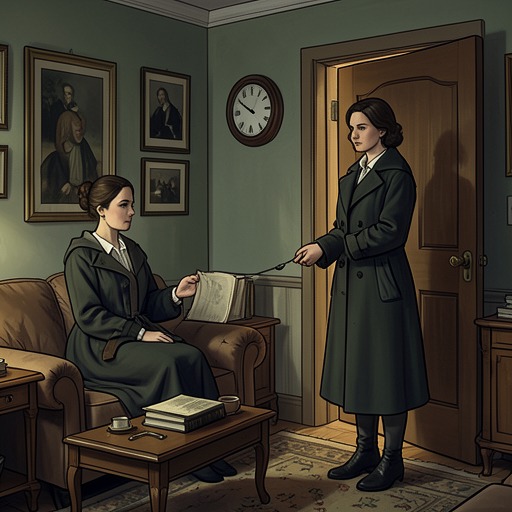
Jane arrives at Anna’s door with a teasing remark about how bored Anna must be with black-and-white films, then folds her into a hug. Anna laughs nervously and has not yet managed to say anything when Jane sweeps past her into the house. The visit begins with Jane setting its pace: she has brought a bottle of cold Riesling, opens it, and soon the two women are drinking together in the kitchen.
Jane smokes one Virginia Slim after another, and smoke gathers beneath the ceiling lights. Anna finds that the wine tastes of smoke but does not mind; it recalls nights during her graduate-school years outside the taverns of New Haven. The scene places a newly welcomed visitor against the private habits of Anna’s solitary life. Jane notices the merlot Anna keeps on the kitchen counter, and Anna explains that she orders it in bulk because she likes it. As they continue drinking, Anna identifies the pills she has as uppers and opens a second bottle, this time of merlot. Their evening proceeds through this loose combination of talk, wine, cigarettes, and play rather than through a formal exchange of introductions.
Discovering common ground
As they talk, Anna and Jane discover that both are mothers of only children. They are also both sailors, a connection Anna had not known about Jane. Jane prefers sailing alone; Anna says she had preferred two-handed sailing, though her phrasing makes clear that this belongs to an earlier period of her life.
Anna recalls her honeymoon with Ed, when the two of them chartered a thirty-three-foot Alerion and cruised the Greek Isles, moving between Santorini, Delos, Naxos, and Mykonos. Jane compares the voyage to Dead Calm. The memory brings a past shared life with Ed into a conversation that is otherwise establishing a new connection, and the difference between Jane’s solo craft and Anna’s remembered sailing with a partner quietly marks two ways of being at sea.
The visit also settles into small domestic details. While Jane studies the chessboard, Anna takes a stick of Toblerone from the refrigerator and cuts it roughly with a kitchen knife; they eat the chocolate at the table as dinner. Anna associates the improvised meal with Olivia, bringing her daughter into the room through a familiar household habit even though she is not present. In a later game, Jane asks whether Anna gets many visitors. Anna answers that she gets none apart from Jane and her son. The question makes the scale of Anna’s isolation explicit: the visit is not one among many, but an exceptional intrusion into a life with almost no callers.
The house opened up
After their second chess game, Jane asks to see the house. Anna hesitates because so few people have examined it from top to bottom. David has done so, but Anna cannot recall who might have before him; Bina has never gone beyond the first story, and Dr. Julian Fielding stays in the library. For Anna, agreeing to the tour feels unexpectedly intimate, like leading a new lover by the hand. The hesitation makes the tour more than a practical look around: Jane is being admitted into spaces Anna usually keeps private.
Jane responds vividly to the rooms. She says the red room makes her feel trapped inside an artery, asks whether Anna has read the books in the library, and then amends the question to whether she has read any of them. Anna giggles. In Olivia’s bedroom, Jane judges the room too small for a growing child and contrasts it with Ethan’s larger room. Anna’s study earns a different response: Jane admires it as a place where a girl could get things done. Her remarks make the tour a conversation about the lives the rooms might contain as well as the rooms themselves.
Later, as Anna considers her next chess move, Jane points to the umbrella leaning against a wall in the living room. Anna explains Dr. Julian Fielding’s backyard therapy: the unsteady walk through the door and down the steps, with the umbrella’s nylon canopy forming a protective bubble against the outside. She recalls the clarity of the outdoor air and the drift of wind. What might sound ridiculous to her becomes something she can describe concretely to Jane: both the difficulty of crossing the threshold and the sensory reward on the other side. Jane calls the account interesting rather than dismissing it.
Acknowledgment and a view beyond the window
The conversation reaches the subject Anna is avoiding when Jane says she is not going to ask what made Anna this way. Anna answers with joking guesses about her weight and prematurely gray hair, but Jane names the condition plainly: agoraphobia. The exchange matters because Jane neither presses Anna for its cause nor treats the subject as a reason to withdraw. She recognizes what Anna is living with while allowing the conversation to continue on Anna’s terms.
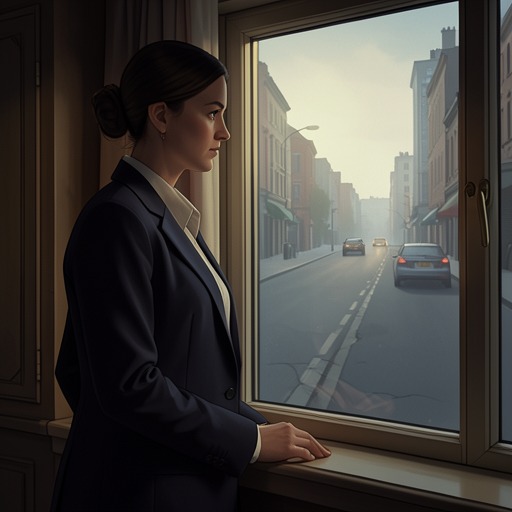
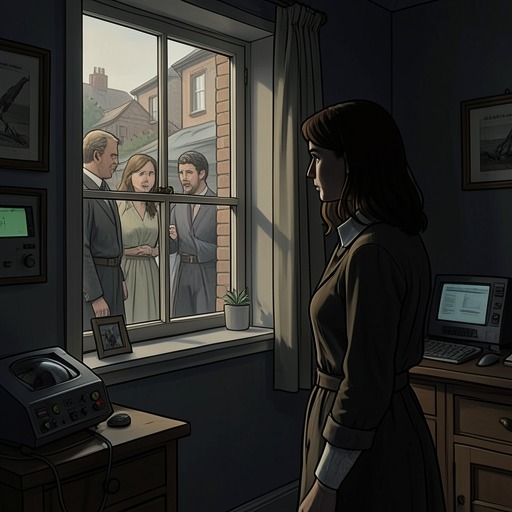
Jane turns to the window and points west. They look at the sunset, where buildings are silhouetted against the fading light and a bird circles nearby. Jane calls the scene nature, and, when Anna qualifies the claim, insists that the world is beautiful. She tells Anna not to forget that and not to miss it. Her words connect the view outside to the umbrella and the therapy Anna has just described: the outdoors is not only the place Anna fears crossing into, but also a source of air, movement, and beauty that remains available beyond the house.
The conversation lasts two and a half hours. Anna searches her memory across the months and seasons for another time she spoke with someone for that long, but cannot find one since her first meeting with Dr. Julian Fielding in midwinter; even then, her damaged windpipe had limited how long she could talk. She feels young and almost giddy, and considers whether wine explains the feeling before deciding that it probably does not. Her final recognition is simple and consequential: she has made a friend. The evening does not end Anna’s isolation, but it gives her a new relationship within it—and a reason to remember the world beyond her windows.